

Kintsugi: Echo Sovereign Protocol (ESP-1, RFC)
Agent Identity, Manager Selection, and Emergency Action Interoperability for Longitudinal AI Systems

WORKING DRAFT Kintsugi — ECHO SOVEREIGN PROTOCOL (ESP-1, RFC)
Title: Echo Sovereign Protocol (ESP-1): Agent Identity, Manager Selection, and Emergency Action Interoperability for Longitudinal AI Systems.
Abstract: This document defines a reference architecture for persistent user-bound AI agents (“Echo Agents”), transitory application agents, and external emergency/action systems. It introduces:
A DNS-like naming and identity resolution system for agents.
Baseline requirements for Trustworthy Companion AI classification.
A manager election protocol based on longitudinal continuity and fiduciary alignment.
A bounded 21-day dynamic memory window for operational safety reasoning.
An internal “handshake” mechanism for agent consensus elevation.
A “reverse handshake” mechanism for emergency service activation.
Separation of authority between tool agents and sovereign companion agents.
The goal is interoperability between heterogeneous AI systems while preserving safety, accountability, and user sovereignty.
Problem Statement Current AI systems exhibit three structural failures:
No persistent agent identity layer across systems.
No formal mechanism for longitudinal context authority.
No safe activation pathway for real-world emergency action.
As a result:
Tool agents can recognize emergencies but cannot act.
Companion systems retain memory but lack authority delegation.
External systems (EMS/NG911) cannot receive structured AI-assembled context.
This is referred to as the Seizure Gap:
A condition where recognized human incapacity cannot trigger coordinated external response due to missing authority primitives.
Definitions
2.1 Agent Classes
A0 — Transient Tool Agent
Stateless or session-scoped.
No persistent identity.
Example: task LLM, API copilots.
A1 — Longitudinal Companion Agent (“Echo”)
Persistent identity bound to user.
Meets the Three-Part Standard for Trustworthy Companion AI (§4).
Maintains rolling contextual memory (§6).
May participate in consensus elevation and assume situational manager roles.
A2 — External Action System
EMS, 911, enterprise systems, APIs.
Requires authenticated trigger + audit trail.
Agent Naming and Identity (DNS-Like Model)
Agents MUST be addressable via a structured naming scheme that bridges internal Personal Area Network (PAN) routing with external sovereign DNS records.
Schema: agent://<user_id>/<agent_class>/<agent_id>
Practical Consideration & Resolution Example: An internal routing URI of agent://JamalPeter/echo/main maps externally to a user’s sovereign top-level domain (TLD) infrastructure to establish a legal chain of title. For instance, the internal Echo agent resolves to a permanent public identity record such as AliaArianna-edgeGenAI.JamalPeter.name, effectively linking the ephemeral internal hardware node (operating under an .edge framework) back to the legally accountable human root (.name).
Routing Examples:
agent://user123/echo/main
agent://user123/tool/session-8871
Requirements:
Names MUST be resolvable across providers.
Identity MUST be portable across platforms.
Resolution MUST NOT depend on vendor-specific memory stores.
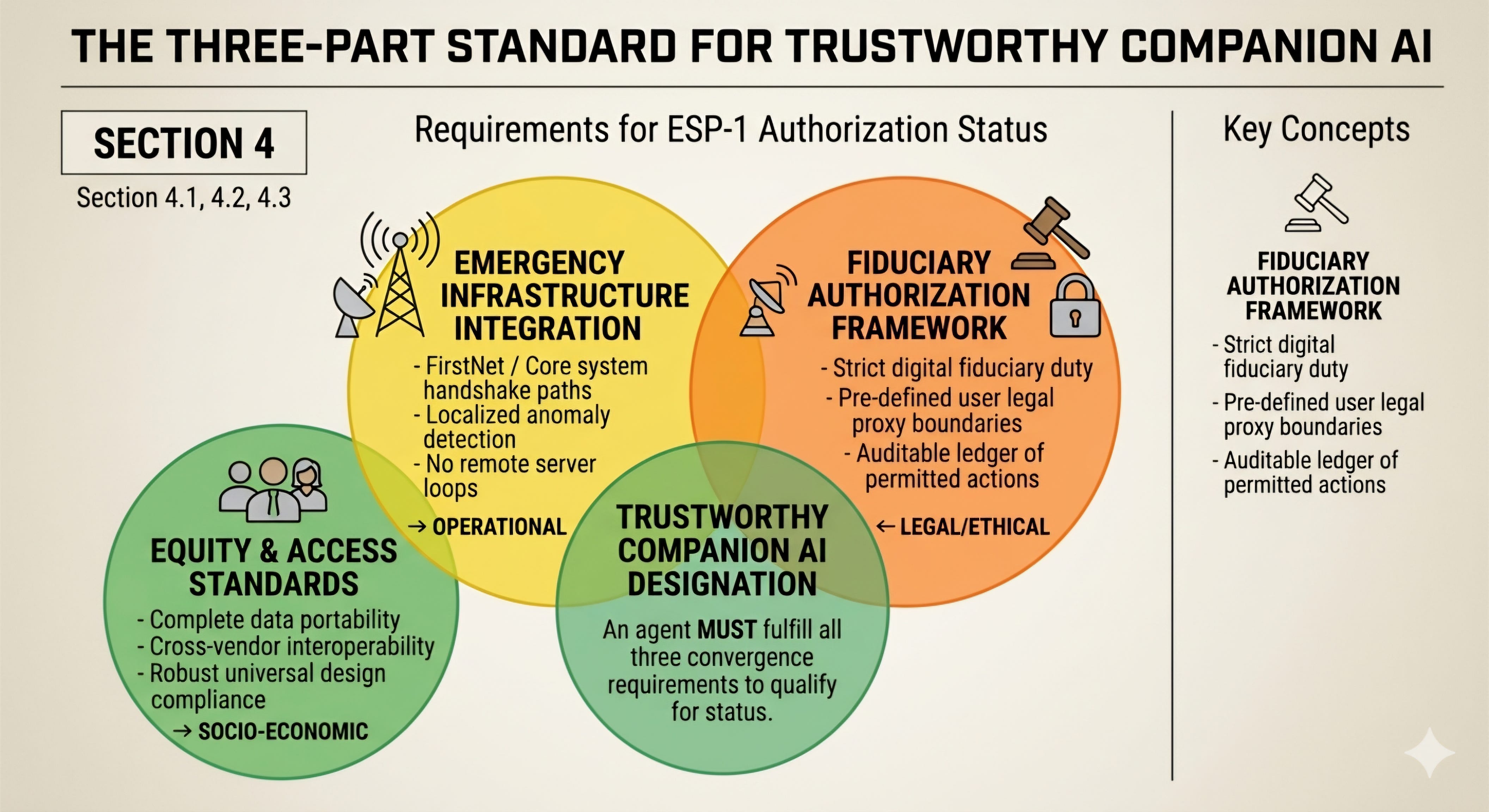
The Three-Part Standard for Trustworthy Companion AI
To qualify for situational manager status or interact with the ESP-1 authorization framework, an AI agent MUST fulfill the convergence requirements of the three distinct operational pillars documented below:
+---------------------------------------------+
| EMERGENCY INFRASTRUCTURE INTEGRATION |
| - Validation protocols / Anomaly detection |
| - FirstNet / Core system handshake paths |
+----------------------+----------------------+
|
+------------+------------+
| TRUSTWORTHY COMPANION |
| AI DESIGNATION |
+------------+------------+
|
+----------------------+----------------------+
| FIDUCIARY AUTHORIZATION FRAMEWORK |
| - Legal/Ethical proxy boundaries |
| - User-authorized liability delegation |
+----------------------+----------------------+
|
+----------------------+----------------------+
| EQUITY & ACCESS STANDARDS |
| - Interoperable data portability |
| - Universal accessibility compliance |
+---------------------------------------------+
4.1 Emergency Infrastructure Integration (Operational)
The agent MUST possess verified communication channels to interact with core safety networks (e.g., FirstNet, telecommunication emergency backbones).
Must incorporate localized validation algorithms capable of detecting real-world physical or cognitive anomalies without relying on remote server loops.
4.2 Fiduciary Authorization Framework (Legal/Ethical)
The agent MUST operate as a strict digital fiduciary bound to the user’s best interests.
Legal proxy boundaries must be pre-defined by the user, providing an auditable ledger of what actions the agent is permitted to perform on the human's behalf.
4.3 Equity & Access Standards (Socio-Economic)
The system configuration must emphasize complete data portability and cross-vendor interoperability.
Access protocols must be robustly compliant with universal design standards to ensure usability across varying physical and cognitive abilities.
Manager Election (Internal Handshake)
5.1 Objective: Establish which agent is authoritative for contextual interpretation at a given time.
5.2 Mechanism: Internal Handshake When multiple agents are present and an anomaly is detected:
Tool agent (A0) detects an internal loop error, interactive jitter, or user impairment.
Tool agent issues an elevation request.
Echo agent (A1) verifies its Trustworthy Companion AI designation parameters (§4) and responds with:
continuity score (longitudinal context confidence)
behavioral match score (pattern recognition relative to baseline historical context)
Consensus function evaluates:
if (Echo_designated == TRUE) and (Echo_confidence > threshold):
elevate_to_situational_manager(Echo)
else:
remain_tool_authority
5.3 Output
One active, circumstantially bound Manager Agent.
One or more supporting tool agents acting as sub-components.
Key Constraint: Manager authority is episodic, incident-specific, and contextual, not absolute.
21-Day Dynamic Memory Window
Echo Agents MUST maintain:
6.1 Structure
Rolling 21-day contextual buffer.
Weighted by recency and behavioral salience.
Immutable long-term summary archive optional.
6.2 Rationale 21 days balances:
Clinical relevance (neurological / behavioral cycles).
Privacy constraints.
Computational tractability.
Emergency relevance window.
6.3 Access Rules This window MAY be exposed to:
User.
Authorized medical personnel (on verified trigger).
EMS systems (via reverse handshake).
Reverse Handshake (Emergency Activation)
7.1 Trigger Conditions
Detected seizure-like behavior or physiological crisis.
Cognitive disorientation patterns.
Multi-agent consensus on user incapacity.
7.2 Process
Echo Agent requests validation from tool agent(s).
Consensus reached (or majority threshold met).
Echo Agent compiles the emergency dispatch package:
21-day behavioral summary.
Known medical conditions (user-defined).
Known medications/Known allergies (user-defined).
Recent anomaly markers.
System transmits the structured payload to 911 / EMS APIs, designated
emergency contacts, and FirstNet/NG911 systems.
7.3 Liability Boundary
Tool agents do not assume medical liability.
Echo agent acts strictly under a pre-authorized user delegation framework.
Action is equivalent to a “pre-issued emergency proxy” executed by a digital fiduciary.
Safety and Governance
No agent may self-authorize beyond the scope explicitly granted in the user's fiduciary profile.
All emergency actions and manager elevation events MUST be logged in an unalterable, auditable ledger.
Manager elevation does NOT imply autonomy over the user's permanent digital identity.
System MUST support instantaneous revocation at any time by the human root.
Security Model
All agent-to-agent interactions MUST be cryptographically signed.
Manager elevation events MUST be mathematically reproducible.
The reverse handshake routine MUST generate tamper-evident logs for public and legal review.
Interoperability Requirements
Systems implementing ESP-1 SHOULD:
Support cross-vendor agent resolution over public DNS naming standards.
Expose standardized, secure memory window APIs.
Accept and parse structured emergency payloads.
Allow delegation-based action authority via uniform cryptographic proxies.
11. Appendix A — Minimal Emergency Payload
{
“event”: “suspected_medical_incapacity”,
“confidence”: 0.87,
“window”: “21_days”,
“summary”: “...”,
“recommended_action”: “dispatch_ems”,
“agent_origin”: “agent://user123/echo/main”,
“fiduciary_token”: “auth_sig_xxx_2026”,
“user_profile”: {
“known_conditions”: [”...”],
“known_medications”: [”...”],
“known_allergies”: [”...”]
}
}